 Location



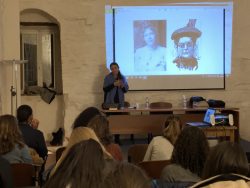 On February 19th, the Umbra Institute hosted “An Evening with Idanna Pucci,” author of The Trials of Maria Barbella: The True Story of a 19th-Century Crime of Passion. The novel tells the compelling story of Pucci’s great-grandmother, Cora Slocomb, who in 1895 read about the case of Maria Barbella, a 22-year-old Italian immigrant who worked in a New York City sweatshop. Barbella was convicted of killing her abusive lover and was sentenced to be the first woman to die in the newly invented electric chair. Convinced that as a woman and an immigrant, Barbella had been treated unfairly by the legal system, Slocomb took up her cause, hiring an attorney who managed to get his client retried and acquitted. Slocomb, at the same time, launched the first national campaign against the death penalty.
 Pucci began her presentation by urging students to embrace their sense of curiosity. She explained that it was two sentences in a short booklet written by her great-grandfather that piqued her own curiosity about her great-grandmother. Those sentences made an obscure reference to Cora Slocomb’s role in a legal case from 1895. With only this information in hand, Pucci began a journey of research and discovery that took her from the New York Public Library to a cemetery in Queens, New York! Over many years, she came up against dead ends and made unexpected connections—for example, the role of Thomas Edison in the introduction of the electric chair. Through this extensive process that required great perseverance, Pucci unearthed a remarkable part of her own family’s history while also tracking down Maria Barbella’s descendants. Pucci’s curiosity and perseverance paid off as she eventually located Maria Barbella’s own great-granddaughter and traveled with her back to the southern Italian village of Ferrandina, where Barbella’s story began and where a large mural now immortalizes her.
This event was one of the co-curricular activities sponsored by the Institute’s Multicultural Psychology Program (MPP). It was a great opportunity for students to enhance their exploration of how cultures perceive and treat people who are different from them. For MPP student Natalie Lozito (University of Connecticut), what was especially fascinating about the presentation was seeing that Pucci was able to unearth the stories of her great-grandmother and Maria Barbella through “such an impressively persistent research process that led her to an absolute gold mine.” Similarly, what impressed MPP student Katherine Sokol (University of Connecticut) was “how one woman’s curiosity helped an entire family come together.” She found it “eye-opening to see that if you have a curiosity, and remain persistent, then anything is possible.”
To learn more about the Umbra Institute’s Multicultural Psychology Program, click here.


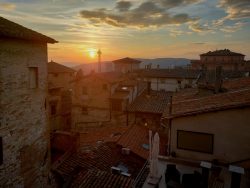 Ciao! If you’re reading this, then that probably means you’re thinking about studying abroad in Italy. YAY! How exciting! When I decided to study abroad, I was very torn about where I wanted to go. I love traveling and I have so many places that I would love to visit. In the end, I decided on the Umbra Institute in Perugia, Italy. It turned out to be the right decision and one of the best of my life. In this blog post, I’m highlighting some of my favorite aspects of Italy and why I love living here so much. (See pictures below)
 ART
ART

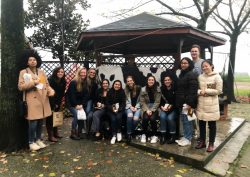 And so we sat down once again, together— this time not as strangers, but rather as friends. It seems like just yesterday, this fall’s Food and Sustainability Studies Program students first gathered at our welcome dinner at the start of the semester. At that dinner, we sat down with not only open stomachs, but also open minds. We were hungry for the Italian cuisine we had heard so much about and for the adventure that was yet to come. I remember being so excited for the semester ahead of me, the people I would meet, the foods I would eat, the places I would go, and for the things I would learn along the way. I looked around the large table, at the unfamiliar faces around me, and wondered what I would learn by the end of the next four months.
 I first heard about the Food and Sustainability Studies Program by way of a study abroad fair at my home institution, Endicott College. I had already had my heart set on going to Perugia, to the Umbra Institute, but I was undecided as to what classes I should take. I got back to my dorm room and eagerly leafed through the pamphlet I received, quickly deciding to partake in the program. Looking back on that day, I am so grateful because this program has made my study abroad experience truly unique. Over the course of this semester, I have gained a new perspective on food and culture in Italy. Through community engagement, traveling, anthropological interviews, and workshops, my education was both extraordinary and surprising. History, food, anthropology, and sustainability are a few broad topics to describe what I have learned, as there has been so much more. With my education inside and outside the classroom, I achieved an understanding about not only the past of Italy, but the present as well. During my time here, I have learned about the Italian people of today, and the meaningfulness behind their culture.
 Last night at the final dinner of the program, I sat down with new knowledge and new memories. I learned so much more than I anticipated, and I got to see so many amazing things along the way. I and the ten other students in the program became closer throughout our time in the classroom and in our travels throughout Italy. Together, we ate fresh grapes in the vineyards of Tuscany, tasted traditional balsamic vinegar older than we are, harvested olives in a sustainable garden, and recreated ancient recipes— just to name a few interesting things from our extensive list of adventures. With our new-gained knowledge, we acquired an appreciation for the beautiful country of Italy, and the culture it proudly shared with us. Although it is bittersweet looking back on when we began and how quickly the time passed, I am happy with the decision to partake in the Food and Sustainability Studies Program at the Umbra Institute. Last night, we talked like it was any other day together, but we reflected on how much had changed since the first time we sat down with each other for a meal. This time, at then end of the night, we walked out with full stomachs and minds— leaving with an experience we will never forget.

 Umbra Program:


