 Location




By Haley Benbow, Harvard University
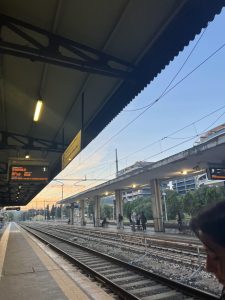
A 6:35 AM meeting time pulled the students of the Green Cities class out of bed bright and early last Friday morning. We had a train to catch. We were heading to Florence to visit Orti Dipinti, an urban garden in the middle of the city, to get a glimpse of what a community garden could become.
First, some background: one of the goals of the Green Cities class is to work in Umbra’s community garden, Orto Sole. The garden is located just outside the historic Piazza IV Novembre, so there is a lot of potential for it to be a well-used green space right by the city center. As a class, we are hoping to propose projects to help the garden reach its potential as a vibrant and flourishing space for both Umbra students and citizens of Perugia. A trip to a place like Orti Dipinti, which is already well established, was very helpful in bringing back ideas and for getting inspiration as to what direction we should begin guiding Orto Sole.
The Mission of Orti Dipinti
Not just a garden, Orti Dipinti fills an important role as an educational space in Florence. The project practices urban organic horticulture and communicates how it can be applied to daily life. It has the goal of teaching people about nutrition, sustainability, new practices in agriculture, and environmental awareness. It promotes a collaborative economy and cooperation among all its stakeholders: citizens, children, students, professionals, tourists, and local farmers. More than that, it serves as a place for people to come together in a passionate and inspired way to work toward achieving greater sustainability and creating a reciprocal relationship with nature.
We were able to hear from Giacomo Salizzoni, the garden’s director, who showed us around and told us about the inspiring history and mission of Orti Dipinti. The visit was certainly that: inspiring. We left Orti Dipinti with camera rolls full of photos, long lists of ideas to bring back, and even our own personal blends of herbal tea from the extensive collection of herbs on site. The work that’s been done in Orti Dipinti over the years has taken the space from an old running track to an urban oasis complete with worm towers, a composting toilet, a zen garden, and plenty of seating for people to gather and relax.

Some of my Takeaways
One of my favorite parts of our visit was listening to Giacomo speak about Orti Dipinti. We spent the first portion of our visit sitting under a plant-covered trellis in the garden’s educational space, while the second half was spent walking around while Giacomo explained all the garden’s different features. The knowledge that he had about all of the plants and other projects was very impressive; it’s clear that he has dedicated a lot of time to making it the lush and thriving space that it is today. This passion that Giacomo makes all the difference in Orti Dipinti; in looking at Orto Sole in this regard, I would love to see that same type of passion for a space fostered in the community of Perugia and in Umbra students.
I also loved the interactiveness of Orti Dipinti. As we took our tour, Giacomo encouraged us to touch, smell, and even taste as many herbs and edible plants as we wanted. It was so cool to experience a garden in this way; I tried herbs that I didn’t even know existed (ever heard of banana mint?). At the end, Giacomo handed us all tea bags to fill with our favorites so that we could take them home, dry them, and brew our own teas.
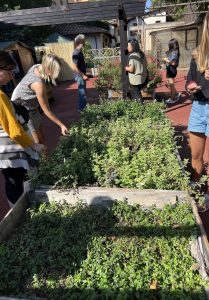
The interactive nature of our visit is also reflected in the way that Orti Dipinti works with its volunteers and the reciprocal nature of that relationship. When describing this aspect of community engagement, Giacomo told stories about how people come to him and ask if they can have a box in the garden to care for on their own. To this he replies, “No, you can’t have one box, but you can have the whole garden.” This ideology of working for the good of the whole rather than for the good of the individual is commendable, and something that I hope will be embedded into the culture of Orto Sole as well.
After having a takeaway lunch from “I Ragazzi del Sipario”, a social cooperative with the goal of employing and empowering people with intellectual disabilities through restaurant work, walking around a rose garden, and spending time wandering through the streets of Florence, we took the train back to Perugia. I was exhausted from the long day, but left feeling excited about all that we saw. It felt like the inspiration that we needed to begin working on our Green Cities class project in Orto Sole.
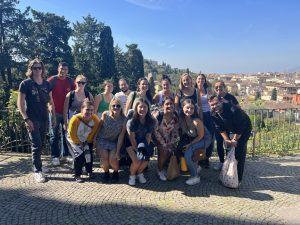
As for Orto Sole, we are at a cornerstone in its evolution; the projects we choose to embark on matter, and will continue to matter, for years to come. Needless to say, it’s an exciting time to be involved and to be a student in the Green Cities class. Like all good things, it will take time and effort, but I believe that Orto Sole can become a thriving source of knowledge and a vibrant space for the people of Perugia and Umbra students in a similar, Orti Dipinti-esque way.
To learn more about Orti Dipinti, or even look into visiting it yourself, you can check out their website here: http://www.ortidipinti.it/en/


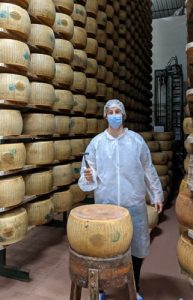
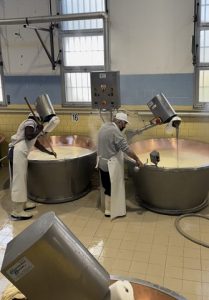 In this factory, we were able to see the milk being warmed, whey being separated, the cheese separating from the milk, the drying room, rein making room, and the aging room. For some reason, seeing the whole entire process makes you feel like you have a stronger connection with the cheese. Instead of mindlessly looking for the name, Parmigiano Reggiano, in the food store, you can look at it and know all the thought that has gone into making a small triangle of cheese. Not only does seeing the process make you have a greater appreciation for the cheese, but understanding that the techniques used to make the cheese today have been the same for many years. There is a long line of hands, minds, and hearts that have carefully considered each technique to make this certain type of cheese in this area. More specifically thinking, the salting room of the factory is where the cheese soaks in order to absorb the salt to preserve it and make the rein. This technique has been used since the Middle Ages and continues today.
 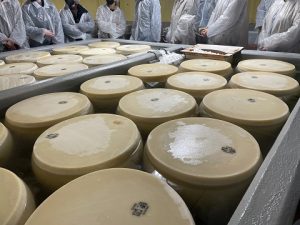 Furthermore, there is a very special “passing of the baton” with the “cheese master”. From the past and to the present, there is a person that is known to be so skilled in knowing if the quality of the milk and cheese is good just by running their fingers through the clumps after the rennet is added. Typically, this is an older man. In the past, before jobs were not as labor intensive, an entire family could be working in the cheese factory. One person could be milking the cows, stirring the whey, adding the rennet, or shaping the cheeses. Normally the elder of the family, or the person with the most wisdom of the cheese, is granted the most respected position of the “cheese master”. This person knows the cheese so well that they can tell if it is perfect just by seeing, smelling, and touching it. This “passing of the baton” has since faded, but adds to the value of the making of cheese and the history behind the factory. It is not only a group of people who are passionate about food and cheese, but a family who is close enough to work together and share their family’s love for cheese with the rest of the world.

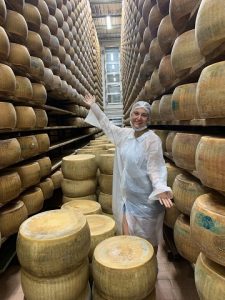 One of my best weekends abroad was when the FSE visited Parma and Modena to tour the Parmigiano Reggiano cheese, Modena Balsamic Vinegar, and Prosciutto di Parma production facilities. Having local food producers walk us through the process of creating these traditional products was an incredible experience, one that I probably would not have gotten if I had studied abroad in a different country. For example, the appellation and DOP/DOCG region system is something that sets Italy apart from the US and other countries for food and wine production. Certifying products from these areas ensures top quality and preserves Italian food culture, but being limited to the specific region boundaries makes it harder for producers and farmers to adapt to changing climate conditions. For example, within the last few decades, the Parmigiano Reggiano cheese producers have had to use air conditioning in their facilities to maintain the correct cheese temperature and they changed the cow breed they use to make the milk. The cheese-making facility also has stainless steel machinery and copper cauldrons for a sanitary production process. This is where the blend of traditional artisanal production techniques and modern technology is critical to maintaining sustainability, of both the business and the local cuisine. And it was a unique experience for me to explore these sustainable examples of food production that exemplify a middle ground between small family farms and massive industrial facilities. This is something that is hard to imagine and get the opportunity to see in the United States.
 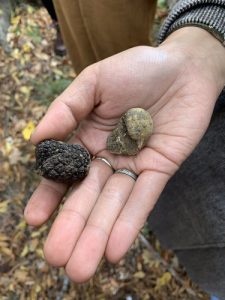 Not only did we participate in facility and farm tours and educational presentations, but we also got to sample the delicious dishes at each of the trip locations! Some of the best meals I’ve had in Italy and in my lifetime have been on the FSE field trips, including gnocchi with truffle oil during the truffle hunting field trip and 25-year aged balsamic vinegar on vanilla gelato in Modena.

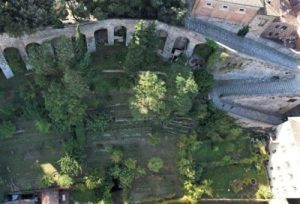
 The Umbra Institute’s didactic garden,

 Opportunities for Teaching & Learning



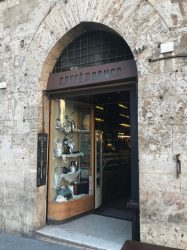
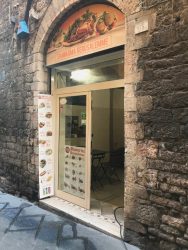 2. Shawarma Gerusalemme – Shawarma Gerusalemme is located a bit farther from Umbra, toward the bottom of Via dei Priori. The food is delicious and fresh, so I assure you that it is worth the walk. Some of their lunch options include Kebab Panino, Panino Hamburgher, Falafel e Humus, Patatine, and even Hot Dogs. The first time you eat here, I would recommend that you ask for a “punch card”. If you bring the punch card each time you eat at Shawarma Gerusalemme, your 11th meal will be free—great for students on a budget!
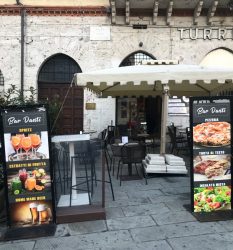 3. Bar Danti – Bar Danti is located in Piazza Danti less than a 3 minute walk from Umbra. They have outdoor seating when the weather is nice and the staff is some of the nicest people I have met while abroad. If you get to know the owners they will treat you like family. Bar Danti has a large array of options including salads, pizza, torta al testo, and smoothies. It is a great place to sit and have a quick lunch with friends.
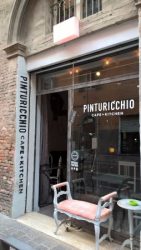 4. Pinturicchio Cafe+Kitchen – Pinturicchio is one of the only American-style cafes in Perugia, offering scrambled eggs, pancakes, cupcakes, barbecue, and much more. The atmosphere is casual and comfortable with many couches and chairs to lounge on. It is about a 10 minute walk from Umbra, but it is the perfect place to go if you want to sit, do homework, and sip a warm cup of coffee.




 According to the website,

 One of the best things about Italy is the fresh, sustainable, and local ingredients found in restaurants and stores everywhere… one in particular is the eggs, never will you see yolks so orange. They’re creamy, fresh, buttery, and oh-so delicious.


 On March 9th and 10th, Dr. Elisa Ascione, Coordinator of the Umbra Institute’s Food & Sustainability Program (FSSP), facilitated the Food, Heritage & Community Conference in Prague, Czech Republic. The goal of the conference, sponsored by
  Among the presenters was Dr. Peter Naccarato, Interim Program Director at the Umbra Institute and Professor of English & World Literatures at Marymount Manhattan College. Dr. Naccarato, presented his paper, “Brooklyn Goes Global: When Local Culinary Culture Becomes a Global Phenomenon.” He explained that this paper was part of a chapter that he and his co-author, Dr. Katie LeBesco, are writing for a forthcoming book on “Global Brooklyn.” The goal of the book is to understand how and why a set of objects, designs, interior decorating, architecture and other practices have traveled from cafes and restaurants in Brooklyn, New York to cities across the world. For their chapter, Dr. Naccarato and Dr. LeBesco are exploring the differences between the actual New York City borough of Brooklyn and the imagined space called “Global Brooklyn.” They consider Brooklyn’s place in the cultural imaginary: Who does and who doesn’t inhabit Global Brooklyn? How do Global Brooklyn’s aesthetic and culinary practices interface with working class and immigrant people who have been displaced within the borough and who have distinctly different eating and drinking practices? What does this mean for the imagined version of Brooklyn that is translated around the world, and how does it impact those who inhabit the “real” physical place?


