 Location




It is almost summertime, the weather is (finally) getting warmer and Umbra staff is preparing for the arrival of summer students. We cannot wait for you to be here and explore our beautiful city of Perugia but we know that traveling will be an important part of your stay. If you’re already doing a bit of research and planning, we would like to give you a few suggestions for places to visit in our region! They include medieval hill towns, a surprising national park in the Apennine mountains, a lake with incredible sunsets, and the tallest waterfalls in Italy. So without further ado, here are some gems for your day trip destinations:
Spoiler alert: Assisi and Orvieto are not on the list. Their beauty is famous well beyond Italian borders.
Le Cascate delle Marmore (Marmore Waterfalls)
In need of a refreshing day? Then, Marmore is the right destination! Offering a range of activities including hiking, rafting, and river walking, this man-made waterfall is the perfect way to take a break from the city.
Originally created by the Romans (271 BCE) to redirect the influx of water to other rivers, and later modified by Aristotle Fioravanti (1422) and others, this three-tiered waterfall still impacts water influx to this day. This journey through Italian architectural ingenuity has inspired countless artists and continues to do so. The surrounding area provides a range of ‘mercatini’ (markets) selling paintings, frames, and more local art to enjoy. Just don’t forget to check the opening times before you go so that you know you’ll get to experience the full majesty of the thundering falls.
From Perugia: take a 1 to 1-hour and 30-minute train to Terni then hop on a 20-minute bus from Terni to the Cascate. Total cost: around 9 EUR
Entry fee: 12 EUR
Link: Cascate delle Marmore Website
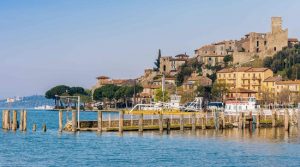 Lake Trasimeno
Hop on a train to Passignano and… rent a bike here or in any other bike store! The Trasimeno bike path unfolds along the lake perimeter. You will pass through typical villages like Torricella, San Feliciano (famous for its sunsets), and Tuoro, where you can take the ferry to Isola Maggiore. Castiglione del Lago is another great town by the lake, full of history and great restaurants. You can easily get there by train.
From Perugia to Passignano by train: 30 minutes by train. Cost: 5 EUR
General Information: Lago Trasimeno Website
Gubbio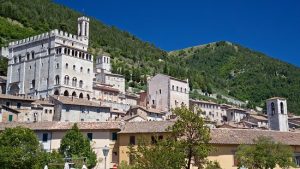
Gubbio is one of the most ancient towns in Umbria, remaining marvelously well-preserved over the centuries, with many monuments that bear witness to its glorious past. Construction began in the early 14th century on the superb complex that includes the Palazzo dei Consoli, a symbol of the town and home of the Picture Gallery and Archeological Museum. Do not miss the Eugubine Tablets (seven bronze tablets written in Umbrian language) at the Civic Museum in Palazzo dei Consoli.
From the Perugia bus terminal in Piazza Partigiani, take the bus E001 to Gubbio: 1 hour and 15 minutes; Cost: 6,50 EUR
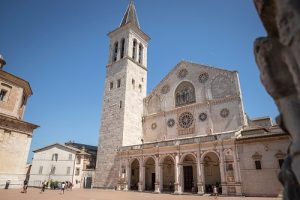
Spoleto
Just an hour’s train ride from Perugia you’ll find Spoleto, a beautiful town complete with a functioning Roman Aqueduct/bridge, intact Roman theatres, cathedrals, local markets with artisan products, and an abundance of historical museums showcasing the rich culture and heritage. The most prominent event is the ‘Festival dei 2Mondi’ (Festival of 2Worlds) founded by the Italo-American composer Gian Carlo Menotti in 1958. This festival takes place during the last week of June and the first week of July and attendees can browse through exhibitions involving art, dance, music, theatre, and more.
Spoleto’s alluring nature and historical importance have made it the protagonist of numerous films and will undoubtedly leave an impression on every visitor.
From Perugia by direct train: 1 hour. The regional train ticket costs 6,80 EUR.
Monti Sibillini National Park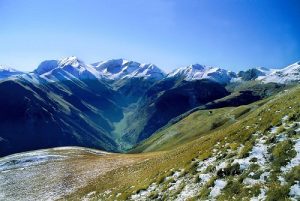
This National Park is really off the beaten track for international tourists! Tucked away within the Apennine Mountains, Monti Sibillini National Park is a wild and wonderful destination in Umbria. Dotted with medieval villages, lakes, and legends, it’s a popular destination for outdoor adventures, such as hiking, biking, rafting, and canyoneering. Wildflowers and wildlife are abundant in the park, from orchids to wolves and birds of prey.
Norcia is the main town in the area, and although it was damaged during the 2016 earthquake, it still preserves its medieval charm. Norcia is also famous for its cuisine, hams, and cheeses, and you will find plenty of affordable shops and trattorie. However, if you decide to invest some more money in a unique food experience, bear in mind that Norcia is home to one of the three Michelin-starred restaurants in Umbria, the Vespasia.
It is not very easy to get to Norcia from Perugia. That is why you might opt for a weekend trip. However, a direct bus connects Spoleto with Norcia in less than an hour at a very low fare.
General information: Monti Sibillini National Park website
If you are looking for more destinations, please refer to our QR handout guides on the second floor once you’re here! Safe travels!


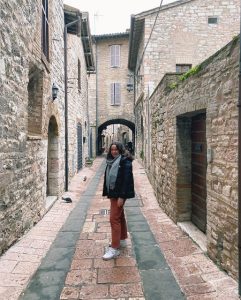


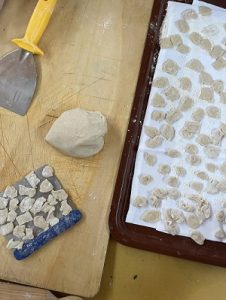 With my outgoing nature, I quickly became acquainted with the people in my program. We went out for an aperitivo, invited each other over for homemade dinners, make-your-own pizza nights, and went out on the town. All of the friends who I met and stayed around were like-minded and also made the decision to come alone to Perugia.

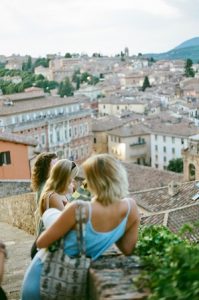
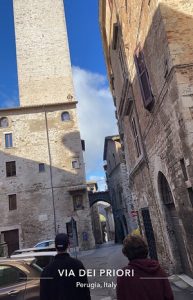 Pictured on the left are two of my roommates walking down the street we live on, Via Dei Priori, on the day we moved in. As you can see, the streets are incredibly narrow compared to American streets – especially when cars drive up and down the street! Whenever a car comes, all the pedestrians huddle on one side to allow the car to pass through. While this was unexpected at first, it is a practice we quickly got used to as we walk streets like this every day. On the left side of the image, there is a large tower: this is Torre degli Sciri, a 13th-century medieval structure, and our next-door neighbor! The tower is now open to visitors for free on the weekends (though tips are appreciated). As my roommates and I explored the city during our first days in Perugia, we decided to climb the tower to check out the view of our new home. The views we were met with were nothing short of breathtaking:
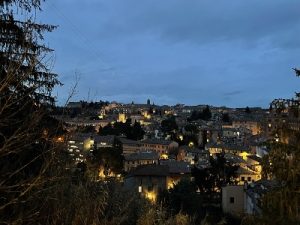
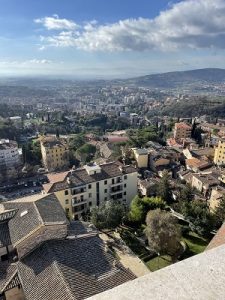 Pictured on the right, the entire city of Perugia can be seen – and beyond! The flat valleys behind the city contrast with the stark mountains in the back that crest above the clouds. Rays of sun shower down from above and illuminate the entire town, allowing the vibrant colors of the houses below to really pop. Additionally, you can see the emphasis on nature I was mentioning above; there are so many trees and green spaces all throughout the city! I wish more American cities followed this European style of city planning and featured more green spaces because they really bring a lot of character to the city of Perugia.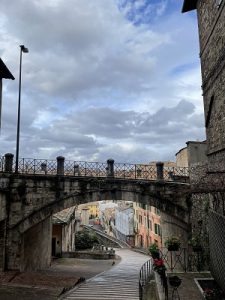
 Learning about ancient Rome, the Renaissance, and food culture while in Italy allows me to have a better appreciation for the city I live in, such as when observing art, walking through ancient streets, or eating at local restaurants. So far, my first impressions of Perugia and the Umbra institute have been resoundingly positive. I have had such a great time so far, and I can’t wait for everything that comes next in my Italian study abroad experience!





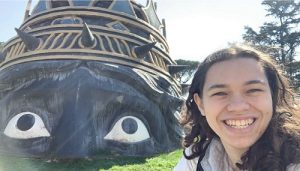 I learned after I entered that the only way to see the sets is to go through an hour and a half tour, but there are only two tours in English, at 11:30, Saturday and Sunday. Not knowing this, I got there at 12:05, just missing the English tour, so I went on the Italian one at 12:30. Here I was fully immersed in the Italian language, no use of google translate or by standards could help translate for me, so auditorially I couldn’t understand what was happening. But looking at the sets, walking through Italian history I was immersed in the past, completely immersed in what the sets once meant. I loved walking through the sets knocking on everything I passed as what looks so real, was completely hallow, fooling millions of viewers and countless patrons visiting the sets.
 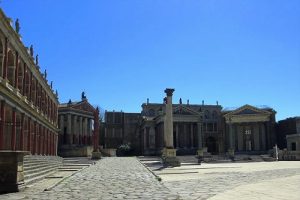 I proceeded to walk around the grounds and go to the museum on site. The museum is filled with facts about how a film is made, costumes from films, and parts of the history of Cinecittà. The spectacular nature of Cinecittà sent me down a deep dive into its historical nature. It was originally created by Benito Mussolini in 1936-1937, as a way for the fascist government to control the Italian film industry, and help shape a more fascist society. After all, Mussolini once said “Cinema, the strongest weapon” understanding the power film had in culture. But after the Allies won World War II the facility was closed, which allowed for the spread of Neorealism (Neorealist films were often filmed on location rather than in sets which allowed for a more authentic representation of Italian civilization.) It was until the 1950s, that the sets were rebuilt and opened for use. For roughly 20 years Cinecittà sets held some of the most famous Italian directors and very prominent Hollywood films. However, as television grew, the quality of films coming out of Cinecittà declined. As a result, the studio became obsolete. In recent years, Cinecittà has been used to film Italian television shows, but it is mostly used as a museum, an homage to the Golden Age of Italian Cinema. For any film enthusiasts, I highly suggest the short train ride to Cinecittà, attend the English-speaking tour, and fill me in on what I missed.


 About the Author:


