Location



Jessica Paholsky (Spring 2012, Pennsylvania State University)
Linkedin Contact, Jessica Paholsky
Current Role: Founder of Once Upon a Pesto, Video Marketing Coordinator at Milton Hershey School
This article is part of Umbra’s Alumni Success Series. Study abroad inspires students from all backgrounds and with all sorts of career goals. Therefore, each article in this series is meant to provide advice and guidance for current and former students interested in pursuing the types of careers our alumni hold, with some offering opportunities to connect by email or LinkedIn for further advice. We encourage you to follow us on LinkedIn so you can read future features!
Umbra: Can you describe your inspiration for Once Upon a Pesto?
Jessica: Shortly after I started my role as video producer at Rodale, Inc.—which at the time was an American publisher of health and wellness magazines, books, and digital properties—I set out on a mission to one day publish a cookbook. Before any pages could be turned, there needed to be a clear and defined vision as well as a topic that wasn’t already saturated in the market. After research, personal reflection, and several idea sketches, I landed on the idea of pesto. Having produced a mini-documentary about olive oil for my college honors thesis—which was inspired by my semester abroad in Italy—I realized pesto was the perfect way to elaborate on my expertise with another classic Italian food product
U: Why pesto?
J: After further research, creative thinking, and planning, my mission became to educate, entertain, and excite others with the fact that pesto is a process. The word pesto derives from an Italian verb that means ‘to crush’ or ‘to grind.’ It’s the same verb from which we get the word pestle (The mortar and pestle was the first culinary tool used to make pesto). That means ingredients from all around the world—not just Italian basil—can be used to make the sauce. Pesto was the gold mine that allowed me to blend several of my passions—storytelling, travel and culture, and food history—into one package. Once Upon a Pesto shares the stories of food and recipes with two main goals: to make other cultures accessible and to inspire creativity in the kitchen.
U: So how did your study abroad inspire your idea and its evolution?
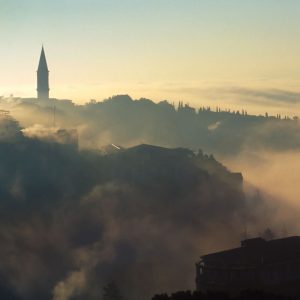
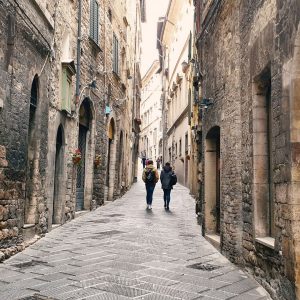
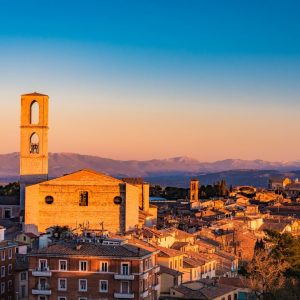
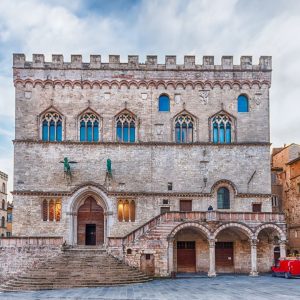
J: My study abroad in Perugia laid the foundation for Once Upon a Pesto. While most of my classmates used our four-day weekends to board short flights to other European nations, I committed my travels to visit 20 regions in Italy so I could gain a true understanding of the nation and its culture. Seeing first-hand the diversity that exists throughout Italy—which can be overshadowed by generalities seen in movies and experienced in foreign restaurants—sparked a curiosity in me to learn about more cultural histories and facts.
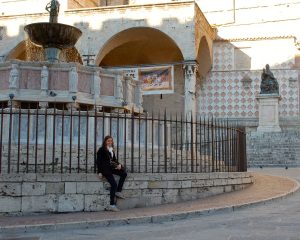
One of the classes I took was The History and Culture of Food in Italy. The lessons and excursions included in this course, no doubt, fed my vision for Once Upon a Pesto and its incorporation of food history on a global stage.
U: Did your time in Perugia lead to more international experiences?
J: Well, fast forward to my first job out of college at a teen travel company where I led and filmed trips in Europe, Costa Rica, and China. My approach to new cultures continued to flourish. As a lifelong learner, I was still hungry for knowledge about other places and people. Once Upon a Pesto, in many ways, satisfies that hunger, and what I love most is that I can share it with others through entertaining and educational content.
My content and brand have given me the platform to be able to nurture relationships with other chefs, home cooks, and travel enthusiasts based throughout the world. Not only do I regularly message and engage with these people through social media, but I also host regular Instagram Live Q&A videos that dive deep into a particular country’s food and recipes. These conversations have featured guests from as far as New Zealand, South Africa, and India to as nearby as Honduras, the Caribbean, and New England.
U: Considering the root of ‘pesto’, what guidance can you provide to future entrepreneurs regarding the process (or ‘the grind’) of starting your own business?
J: Much like making pesto the old-fashioned way by hand with a mortar and pestle, working toward a challenging goal brings about something special, something more flavorful, something very rewarding. I’m not a chemist, but it’s said that pesto made by hand in a mortar and pestle allows the ingredients to break down individually and then integrate with each other in ways not possible by pushing a button and letting an electric blender do all the work. In the same way, a deserving achievement takes time and dedication—‘the grind’—and brings to its laborer something greater than if the project were easy or completed by someone (or something) else. I can’t help but summarize this analogy using a quote from the late Kobe Bryant: “Great things come from hard work and perseverance. No excuses.”
U: Have you experienced any difficulties in business ownership that were made easier by lessons learned from study abroad?
J: One of the biggest hurdles I recently overcame was putting myself directly into my brand. This is where three key lessons I learned during my study abroad came into play.
- The first lesson: Take risks. I look back at my solo weekend travels across the Italian peninsula and realize how much I was stepping outside of my comfort zone. I was pushing myself to new personal growth beyond the shy teen I was when entering college. Putting myself out there as part of my brand was new and risky. But would it hurt my path to success? Was I ready to make that level of commitment? The answers were no and yes, respectively. Soon after I made the brand change, Once Upon a Pesto experienced increased growth in followers and I saw more personal connections develop across the world because people were now seeing a face in front of the brand.
- The second lesson: Have a plan. Those weekend travels from my semester base in Perugia were not haphazard. Each trip throughout the four months I was abroad was carefully and thoughtfully planned out to every last detail—where the train stations were, which hotel or bed and breakfast received good reviews but was reasonably priced, how many sites I could trek to on foot or public transit, and if it was more practical to cover multiple nearby cities in one weekend or split them up. Venturing to the front side of Once Upon a Pesto with my presence required weeks of planning and mapping out my next steps. This included everything from the content pieces themselves to the style, frequency, and distribution of each piece.
- The third lesson: Set time-based goals. It wasn’t until about a week into my semester in Perugia that I decided I wanted to visit 20 regions of Italy during the next four months. When I set a goal, there’s no wasting time or waiting for things to happen on their own. Similarly, my shift with Once Upon a Pesto was completely intentional and goal-oriented. I wanted to establish myself as my brand’s storyteller, front and center. In my experience, goals are more likely to be achieved when they are time-based. Therefore, I listed out my transition plan, week by week, including updates to my website and social media profiles.
U: Can you share any lessons from studying abroad that have benefited you as a businesswoman?
J: The lessons study abroad inspires are priceless. They benefit students both personally and professionally for years thereafter. For me, these lessons involved strengthening my managerial skills, enhancing my independence and courage, practicing frequent and effective cross-cultural communication, intensifying attention to detail, and elaborating on strategic problem-solving. When I take the time to reflect on my study abroad—the places I traveled, the people I met and talked to, the coursework and projects, and the apartment-style living—each of these lessons reminds me of how transformational and transferable the experience is. I see each lesson still present in and growing my character, my work style, my interactions and relationships, my career, my hobbies, and Once Upon a Pesto.
U: Do you have any remaining advice regarding business leadership that you’d like to share?
J: For Umbra’s current and prospective students, my three tips are:
- Step outside your comfort zone: During my study abroad, I wasn’t afraid to travel solo and off the beaten path to places that weren’t necessarily top-of-the-list among other students.
- Make each day count: While a whole semester may seem like a long time, it really goes by fast so it’s important to try to accomplish something new, different, or memorable each day.
- Understand the value of developing connections: As a storyteller by trade, I listen intently to each person I interact with, and that’s how lasting relationships start. Many relationships I formed during my study abroad continue in my life today.


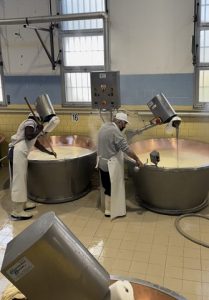 In this factory, we were able to see the milk being warmed, whey being separated, the cheese separating from the milk, the drying room, rein making room, and the aging room. For some reason, seeing the whole entire process makes you feel like you have a stronger connection with the cheese. Instead of mindlessly looking for the name, Parmigiano Reggiano, in the food store, you can look at it and know all the thought that has gone into making a small triangle of cheese. Not only does seeing the process make you have a greater appreciation for the cheese, but understanding that the techniques used to make the cheese today have been the same for many years. There is a long line of hands, minds, and hearts that have carefully considered each technique to make this certain type of cheese in this area. More specifically thinking, the salting room of the factory is where the cheese soaks in order to absorb the salt to preserve it and make the rein. This technique has been used since the Middle Ages and continues today.
 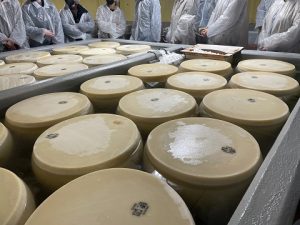 Furthermore, there is a very special “passing of the baton” with the “cheese master”. From the past and to the present, there is a person that is known to be so skilled in knowing if the quality of the milk and cheese is good just by running their fingers through the clumps after the rennet is added. Typically, this is an older man. In the past, before jobs were not as labor intensive, an entire family could be working in the cheese factory. One person could be milking the cows, stirring the whey, adding the rennet, or shaping the cheeses. Normally the elder of the family, or the person with the most wisdom of the cheese, is granted the most respected position of the “cheese master”. This person knows the cheese so well that they can tell if it is perfect just by seeing, smelling, and touching it. This “passing of the baton” has since faded, but adds to the value of the making of cheese and the history behind the factory. It is not only a group of people who are passionate about food and cheese, but a family who is close enough to work together and share their family’s love for cheese with the rest of the world.

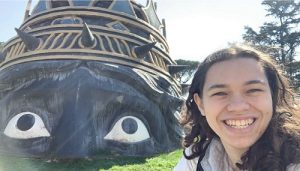 I learned after I entered that the only way to see the sets is to go through an hour and a half tour, but there are only two tours in English, at 11:30, Saturday and Sunday. Not knowing this, I got there at 12:05, just missing the English tour, so I went on the Italian one at 12:30. Here I was fully immersed in the Italian language, no use of google translate or by standards could help translate for me, so auditorially I couldn’t understand what was happening. But looking at the sets, walking through Italian history I was immersed in the past, completely immersed in what the sets once meant. I loved walking through the sets knocking on everything I passed as what looks so real, was completely hallow, fooling millions of viewers and countless patrons visiting the sets.
 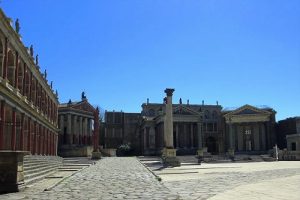 I proceeded to walk around the grounds and go to the museum on site. The museum is filled with facts about how a film is made, costumes from films, and parts of the history of Cinecittà. The spectacular nature of Cinecittà sent me down a deep dive into its historical nature. It was originally created by Benito Mussolini in 1936-1937, as a way for the fascist government to control the Italian film industry, and help shape a more fascist society. After all, Mussolini once said “Cinema, the strongest weapon” understanding the power film had in culture. But after the Allies won World War II the facility was closed, which allowed for the spread of Neorealism (Neorealist films were often filmed on location rather than in sets which allowed for a more authentic representation of Italian civilization.) It was until the 1950s, that the sets were rebuilt and opened for use. For roughly 20 years Cinecittà sets held some of the most famous Italian directors and very prominent Hollywood films. However, as television grew, the quality of films coming out of Cinecittà declined. As a result, the studio became obsolete. In recent years, Cinecittà has been used to film Italian television shows, but it is mostly used as a museum, an homage to the Golden Age of Italian Cinema. For any film enthusiasts, I highly suggest the short train ride to Cinecittà, attend the English-speaking tour, and fill me in on what I missed.