 Location



Each summer, students opt to explore archaeology in Italy through the Umbra Institute’s Summer Archaeology Field School. The program is unique in how it blends in-class learning with field experience and the exploration of sites across Italy.
About the Dig Site
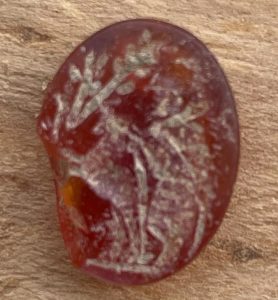
This year, the field school began digging at a new site near Castiglione del Lago. While it was expected that the site would hold answers to the region’s questions about its Roman history, it was not expected that the site would so quickly begin to offer its insight! Within days of starting the dig, students found an old Roman coin and an ancient amber intaglio (pictured to the left).
About the Courses on Archaeology in Italy
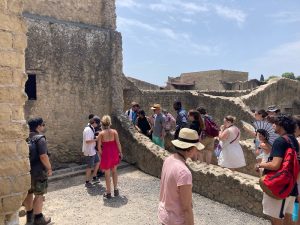 Being in Italy gives Field School participants plenty of hands-on experiences. This is true even beyond the dig site as while students take ARCH/CLAS 325: Archaeology in Central Italy: the Etruscan and Roman Heritage, they get the opportunity to explore unique archaeological sites such as Pompeii. Last weekend, the cohort visited Pompeii where they received an in-depth tour with their professors. They discussed the history of the old city and aspects of its culture revealed by archaeologists over the years. In addition to Pompeii, the group also visited Ercolano and Oplontis, as well as Napoli’s archaeological museum.
Other sites that this summer’s students have visited include Perugia’s Archaeology Museum and the 1416 festival during which they saw Etruscan artifacts and discussed Roman conquest; a visit to Assisi and Spello where they learned about Roman society; and a tour of Trasimeno and Isola Maggiore where they learned about the Battle of Trasimeno.
Would you like to learn more about the Field School?
Click here to read more about the program with the Umbra Institute and check out the program-specific WordPress site that includes a student blog and details about community outreach.


 The Umbra Institute offers a competitive and fully hands-on
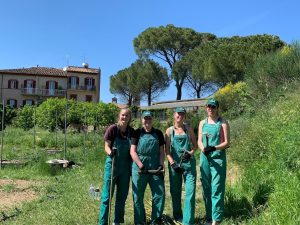
 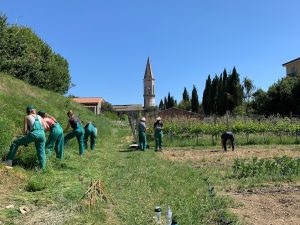 During the whole month of June, the Umbra Institute’s interns went twice a week to a fifteenth-century monastic compound just down the hill from Perugia’s historic center. The complex, begun around 1000 C.E., was the site of Perugia’s first agricultural school and more recently became the headquarters of the University of Perugia’s School of Agriculture. Eight years ago professors and students in the Ag School started the Green Team, a group of volunteers who built a two-acre community garden inside the monastery complex’s walls. In addition to professors and Ag students, members of the surrounding Borgo XX Giugno neighborhood joined in the work of planting, weeding, and watering twice a week. Among the objectives of a community garden is producing healthy food, but another much more important goal for most urban gardens is producing community.
 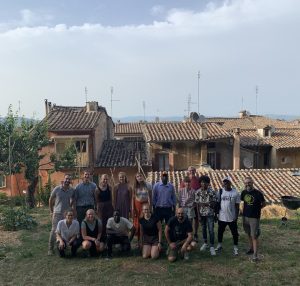 It was in this spirit that Professor David Grohmann and his colleagues of the Green Team invited Umbra’s Orto Sole interns to join them each Wednesday and Friday in the garden at San Pietro. Umbra’s students have worked beside their Italian peers, together with the older residents of the neighborhood; as they water the plants there, they soak in ideas about how to further develop Orto Sole and its “organic” connections to the surrounding neighborhood.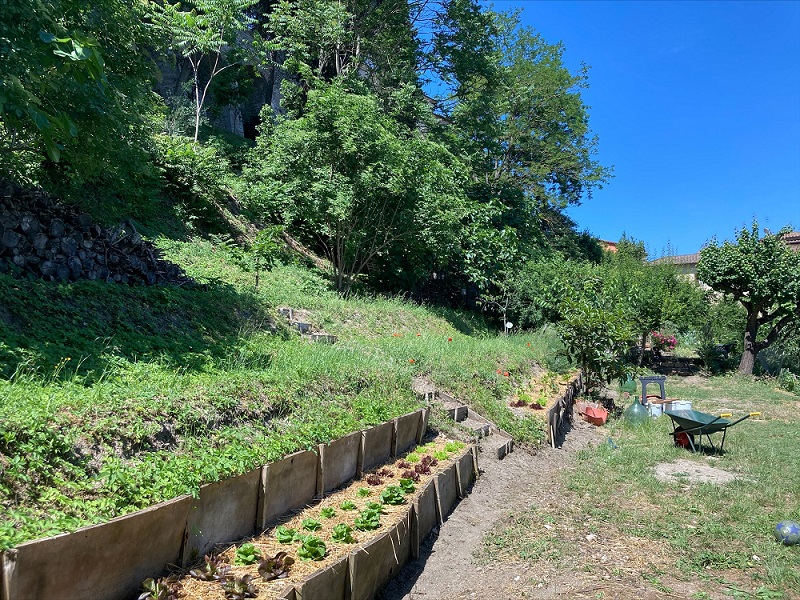


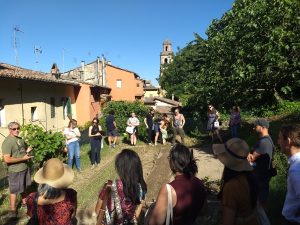 People, food, and agricultural products are in constant movement, affecting landscapes, material practices, and cultural representations. This fifth Food & Sustainability Studies Conference aimed to examine the effects of these movements on local, regional, national, and international communities, and how the Covid pandemic has altered (or shaped) these movements. In particular, the conference sought to understand continuities/discontinuities in current and past long-distance food exchanges, the relationships between “authentic” and diasporic foodways, the forced movement of agricultural workers and their crops in the face of climate change and a global pandemic, and the impact of economic and social disparities on current and future food movements. By posing these questions, the conference offered a wide range of perspectives that contemplated intersections between the Food Studies realm and other fields, such as education, activism and social movements, identity politics, literature, migration studies, geography, hospitality, and environmental studies.
