Location




The Umbra Institute Community Garden Project at Orto Sole keeps flourishing. In particular, one of the Program trainees, Katie Kurtz, provided a priceless and fundamental contribution to the Orto Sole Project, staying with us a bit longer than the rest of the team. Enjoy her blog about her experience in Perugia and at the Umbra Institute!
Season Premier of Orto Sole: 2022 Summer Recap!
Hi everyone! Katie here! This summer I’ve worked as an intern in Orto Sole, The Umbra Institute’s school garden. I’ve helped with everything from growing tomatoes to planning activities for the local middle school. As the summer wraps up, you might be wondering, how did the “season premier” of Orto Sole go for the summer?
THE BEGINNING OF THE 2022 ORTO SOLE SUMMER
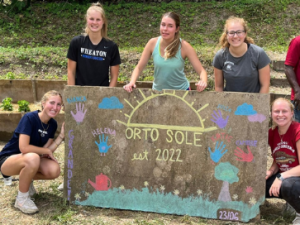 The beginning of the summer was mostly spent on physical projects, turning the overgrown, terraced plot of land into a functioning garden. A typical workday started at 9am with the fundamentals of gardening: weeding and watering. This year we attempted many annual crops throughout several different garden beds, so we were constantly battling the weeds that crept through our mulch. In June, most of my projects were physical – we’d spend several days fixing wooden stairs throughout the garden, clearing new raised beds for next summer, staking and pruning tomato plants, and clearing bushes from the archways located at the top of our garden. One archway is large enough to become an outdoor classroom, so we worked to clear the overgrown bushes from its entrance, flatten the ground, remove large pieces of trash, and plan for this new didactic space.
Umbra’s Partnership with Tamat and the University of Perugia Agriculture Department
Another unique part of June was our relationship with TAMAT, a local organization working to integrate immigrants in to the Perugian community. Each workday several immigrants would join us in the garden, working alongside us on the projects for the day. Working with these immigrants was such a powerful experience for all of us interns – just like us, these immigrants were foreigners and had varying levels of Italian. Despite being from different backgrounds, our work in the garden acted as a bridge and allowed us to form relationships in such meaningful ways.
Several days a week we headed over to Orto San Pietro, a community garden connected to the Agriculture Department at the University of Perugia. Working alongside agriculture students, professors, and community members participating in the urban garden, we cleared beds, pruned tomato plants, built compost bins, and worked to repair their garden after a hailstorm came through and damaged many of the plants. My work at San Pietro has taught me valuable skills such as how to design and run a drip irrigation system, how to care for plants such as beans and tomatoes, and the best way to prepare for a winter garden. We’ve been able to transfer these skills back to Orto Sole, helping us think strategically about how to transition our garden into the fall and winter, and what adjustments we should make for next year to improve our efficiency and output.
Environmental education and strategic planning
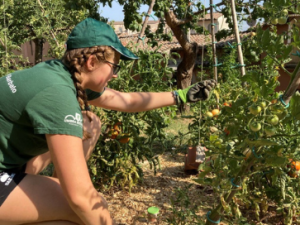
Come July, the other 4 interns headed back to the United States and I’ve stayed in Perugia to maintain the garden while turning most of my energy to the academic side of Orto Sole. The beauty of this space is its proximity to various communities within Perugia, allowing The Umbra Institute to interact with many groups of people and create a didactic space that also improves community engagement. I’ve mostly worked on two large projects: an environmental education curriculum and strategic planning for the following year. The Umbra Institute is working to integrate a community engagement component into their Italian classes, so I developed a set of Italian-English language exchange lessons using Orto Sole. These lessons are geared towards a local middle school and use the garden as the interactive space for students to practice vocabulary. I’ve also worked to plan for upcoming projects with Orto Sole, helping record observations from this summer and necessary adjustments for further iterations of Orto Sole’s summer garden. I’ve catalogued the annuals we grew this year: noting which worked well, potential ideas for new varieties, and how to maximize our growth to effort ratio for the upcoming summers. I’ve also worked on a nectary calendar, allowing us to understand when the plants we have bloom and where we can add perennials to improve our garden from a pollination standpoint. This planning allows us to effectively develop projects for potential volunteering opportunities, next year’s internship, and academic partnerships with Umbra Institute classes. It has been exciting thinking about the potential for the garden over the next 5-10 years!
 ON WHY ORTO SOLE MATTERS
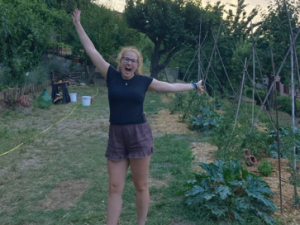
Orto Sole has been so much more than just an office for me this summer. It has been a place of community, a place to escape the noise of the city, and a place to reflect and get to know myself better than before. Spending several days a week working on simple projects, such as weeding a flower bed or pruning plants, created space to build friendships, slow down, and connect to the earth in a tangible and valuable way. Having such a beautiful space within the historic city center allows Umbra students and Perugian residents alike to take a moment to reflect, be in community, and step beyond traditional boundaries that can limit genuine connections from forming with people from all around the world.
While Orto Sole has many years ahead of it to become a fully developed, integrated, and flourishing community garden, this first summer of work was a tremendous success. The space physically resembles a cared-for garden, something one could not say in the middle of May. Orto Sole hosted several events for the Umbra Institute’s Intensive Italian program, such as the 4th of July barbecue and Italian music night, already integrating the space into every Umbra student’s time in Perugia. We’ve had a successful harvest of lettuce, tomatoes, basil, zucchini, cherries, figs, peas, swiss chard, and many other fruits and vegetables, paving the way for the vegetables planted next year and our long-term plans. I have been so lucky to call Perugia home this summer and be a part of Orto Sole’s “season premier,” and I can’t wait to come back and see the growth of the garden as the seasons go by!
Katie Kurtz
Bowdoin College


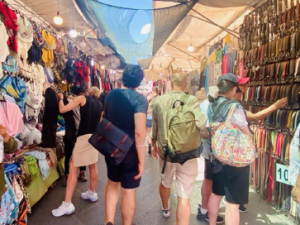 The Chicago School students and their professor PhD Rocco Catrone had some nice adventures exploring Italy and the community-immersive learning experience The Umbra Institute so much stands (and works) for. This Summer Session 2 Semester at Umbra was, in fact, blessed with the company of many faculty-led groups visiting us.


 Since 1971, all contraceptive methods have been fully legal in Italy. Over-the-counter contraceptive methods can be easily obtained at any pharmacy and store (such as male and female condoms), while
 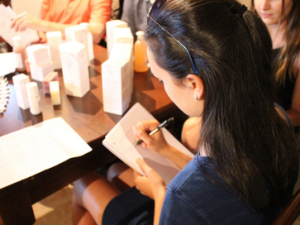 Do you want to consult specific resources and research about Reproductive Health in Italy? Try to check out these materials:

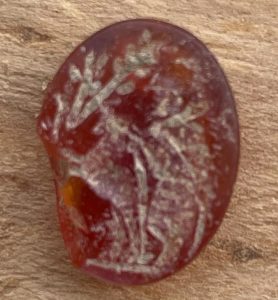
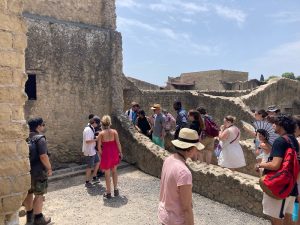 Being in Italy gives Field School participants plenty of hands-on experiences. This is true even beyond the dig site as while students take

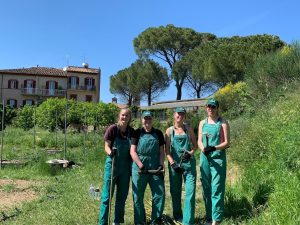 The Umbra Institute offers a competitive and fully hands-on
 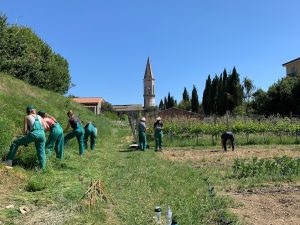 During the whole month of June, the Umbra Institute’s interns went twice a week to a fifteenth-century monastic compound just down the hill from Perugia’s historic center. The complex, begun around 1000 C.E., was the site of Perugia’s first agricultural school and more recently became the headquarters of the University of Perugia’s School of Agriculture. Eight years ago professors and students in the Ag School started the Green Team, a group of volunteers who built a two-acre community garden inside the monastery complex’s walls. In addition to professors and Ag students, members of the surrounding Borgo XX Giugno neighborhood joined in the work of planting, weeding, and watering twice a week. Among the objectives of a community garden is producing healthy food, but another much more important goal for most urban gardens is producing community.
 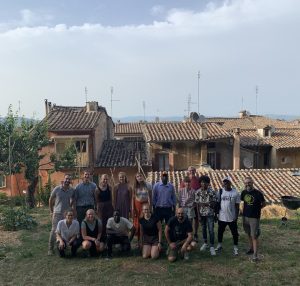 It was in this spirit that Professor David Grohmann and his colleagues of the Green Team invited Umbra’s Orto Sole interns to join them each Wednesday and Friday in the garden at San Pietro. Umbra’s students have worked beside their Italian peers, together with the older residents of the neighborhood; as they water the plants there, they soak in ideas about how to further develop Orto Sole and its “organic” connections to the surrounding neighborhood.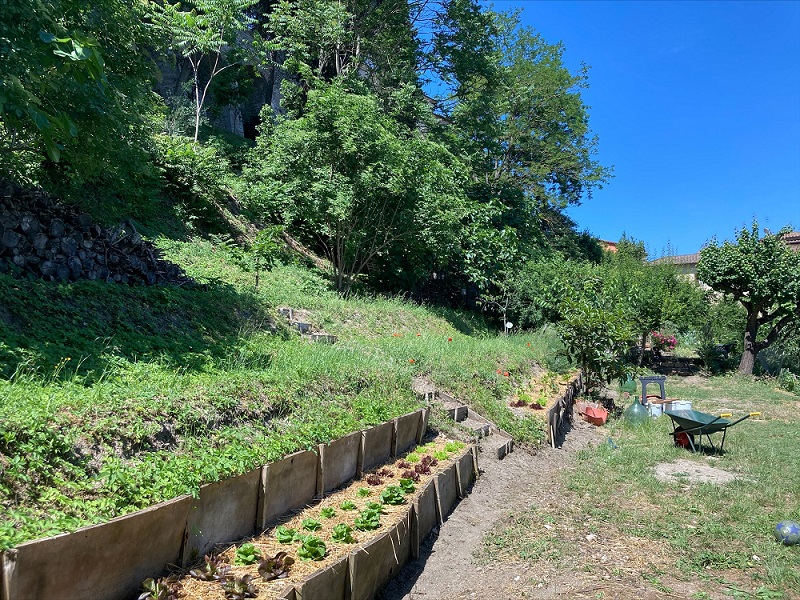


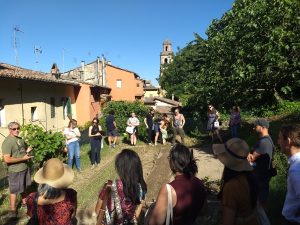 People, food, and agricultural products are in constant movement, affecting landscapes, material practices, and cultural representations. This fifth Food & Sustainability Studies Conference aimed to examine the effects of these movements on local, regional, national, and international communities, and how the Covid pandemic has altered (or shaped) these movements. In particular, the conference sought to understand continuities/discontinuities in current and past long-distance food exchanges, the relationships between “authentic” and diasporic foodways, the forced movement of agricultural workers and their crops in the face of climate change and a global pandemic, and the impact of economic and social disparities on current and future food movements. By posing these questions, the conference offered a wide range of perspectives that contemplated intersections between the Food Studies realm and other fields, such as education, activism and social movements, identity politics, literature, migration studies, geography, hospitality, and environmental studies.


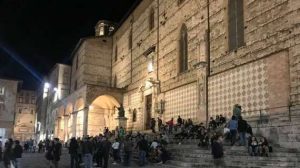 bar, an American-owned bar which always has a huge ground outside, but even though it’s an American bar, there is no shortage of Italians outside. Or maybe you’ll decide to walk around the corner to Marla’s, a two-floored bar which normally hosts live music. There are also plenty of great areas away from the main piazza and great spots to practice your Italian the further you go from the piazza as they are where the locals tend to hang out. Streets like Corso Cavour and Via della Viola are great areas to interact with the locals. Via della Viola, with fun places like C’era una Vodka or Agricola, is very interesting as you can hear street musicians playing well into the late hours of the night. But watch out as you may have to squeeze to the sides of the street every once in a while as an unfortunate driver tries to navigate through the crowds of people! If you’re into dancing, maybe you’ll visit one of the few discotecas right outside the city, although I personally haven’t visited them as nobody wants to see my dance moves. Or better yet, you may even run into some of the Umbra Institute staff at Elfo’s Pub right off of Via dei Priori collectively enjoying a soccer match on the large projector there. There is no shortage of great venues and spots for all here in Perugia.
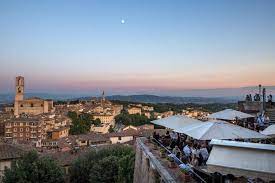 Despite all these great places I’ve mentioned, they’ve not been the most memorable part of the nightlife for me here in Perugia. The most memorable for me by far, has been the people. What makes Perugia fundamentally different from a larger city, is the fact that you really feel like a part of the city and community. I have had the wonderful opportunity to meet people from around the world here, not just from Italy but from countries far and wide like Canada, Spain, France, Russia, South Africa, Germany and more. Perugia feels like a melting pot where everyone is open to meeting new people. In larger cities, people are often wary of those they don’t know and will only stick to their friend group. Here in Perugia I’ve found myself engaging in conversations with people from different countries and cultures, with widely different ages and backgrounds. The people here are excited to meet new people and hear their stories.